Weighted Blankets for Autism: Honest 2026 Guide to Benefits, Safety & Best Picks
Evidence check (October 2026): in a randomized controlled trial of 73 autistic children aged 5-16, weighted blankets did not improve sleep compared with regular blankets when sleep was measured objectively (NHS summary). Some people still find the pressure comforting, so a weighted blanket can be worth trying, but it is not a sleep treatment.
If you try one: the person must be able to move it and get out from under it on their own. Never use weighted blankets or sleep products with babies or toddlers. If sleep problems continue, talk to your doctor.
I’m Dror, and my son Saar is autistic. This guide pulls together what the research actually says about weighted blankets, how to pick the right weight and fabric, how to use one safely, and a short list of blankets worth considering if you decide to try one.
What Is a Weighted Blanket?
A weighted blanket (also called a sensory blanket or gravity blanket) spreads gentle, even pressure across the body. Most contain glass beads or plastic pellets sewn into small pockets. Others are knitted from thick cotton yarn, with no beads at all. The steady pressure is often described as feeling like a firm hug.
How Deep Pressure Is Supposed to Work
The idea comes from proprioceptive input: your body’s sense of pressure, position, and movement through muscles and joints. Many autistic people seek out firm pressure (tight hugs, heavy covers, squeezing into small spaces) and describe it as grounding. A weighted blanket is one easy way to get that input without needing another person’s touch.
What the Research Actually Shows
You’ll see many websites claim that weighted blankets “release serotonin and melatonin” or “lower cortisol.” Those claims are not backed by good studies in autistic people. Here is what we do know:
- Sleep in autistic children: the largest trial so far (Gringras et al., Pediatrics, 2014) found no improvement in how long or how well children slept, measured with sleep-tracking devices. Parents and children did, however, generally prefer the weighted blanket.
- Calm and comfort: evidence is limited to small studies and personal reports. Many people say they feel calmer under the weight. Others feel trapped or too hot.
- Bottom line: treat a weighted blanket as a comfort tool that some people love, not as a treatment. Try it, watch how the person responds, and let them decide.
Why Some Autistic People Like Weighted Blankets
Winding Down at Bedtime
Sleep problems are very common in autism. Research hasn’t shown that weighted blankets make people sleep longer, but some families find the blanket becomes a helpful part of a predictable bedtime routine, and that predictability can make settling down easier.
Feeling Calmer and More Grounded
Anxiety commonly co-occurs with autism. Some autistic people describe the steady pressure as calming and grounding, especially after a long, noisy day.
Predictable Sensory Input
Many autistic people experience the world as loud, bright, or unpredictable. A weighted blanket gives steady, predictable input that the person controls completely.
Before Overload, Not During a Meltdown
Some parents report that a weighted blanket helps during quiet time when they notice early signs of overload. During an active meltdown, adding weight can make things worse. Never put a blanket on someone who doesn’t want it, and never use it as a restraint.
Comfort Without Touch
For people who dislike hugs or being touched, a weighted blanket offers a hug-like feeling they can control and remove whenever they want.
| What people hope for | What the evidence says |
| Longer, deeper sleep | Not shown in the largest trial in autistic children |
| Feeling calmer | Commonly reported; limited research |
| Sensory comfort | Many people like the pressure; others dislike it |
| Fewer meltdowns | Personal reports only; use before overload, not during |
| Comfort without touch | Works for people who enjoy pressure but not hugs |
Choosing the Right Weighted Blanket
Calculating the Correct Weight
The common guideline is about 10% of body weight. For children, start at or below 10% and ask your doctor or occupational therapist. Adults often go up to 15%. Heavier is not better: the person must always be able to push the blanket off without help.
| Body Weight | Typical Blanket Weight |
| 50 lbs | about 5 lbs |
| 75 lbs | about 7 lbs |
| 100 lbs | 10-12 lbs |
| 150 lbs | 15-20 lbs |
| 200 lbs | 20-25 lbs |
Size and Coverage
Weighted blankets are meant to cover the person, not the whole bed. Pick a size that covers the body without hanging far over the edges, because a heavy blanket that slides off the side pulls on the sleeper. For children, buy for their current size rather than one they’ll “grow into.”
Fabric for Sensory Comfort
Fabric can make or break it. A scratchy or hot blanket gets rejected no matter how good the weight feels.
- Cotton: breathable, soft, easy to wash
- Bamboo viscose: cool and silky; good for people who run hot
- Minky: very soft and plush, but warm
- Chunky cotton knit: no beads, no rustling sound, very breathable; great for people sensitive to noise or texture
Filling
Glass microbeads are the most common: small, quiet, and evenly spread. Plastic pellets are cheaper but bulkier and can be noisy. Knitted blankets have no filling at all. Whatever you choose, look for small, box-stitched pockets so the weight doesn’t slide to one side, and buy from a seller with clear material information.
Helpful Features
- Removable, washable cover: almost essential for kids
- Small pockets (box stitching): keeps weight even
- Lap pads and shoulder wraps: lighter options for daytime, school, or travel
- A good return policy: since responses vary so much, this matters more than any feature
Weighted Blankets Worth Considering
How I chose these: I don’t sell these products and haven’t tested them all myself. I picked them for features that matter for autistic users: the right weights for children, washable covers or fully washable designs, breathable fabrics, and quiet fillings. Prices change often, so check the current price before you buy.
Disclosure: some links on this page are affiliate links (Amazon Associates and Awin). If you buy through them I may earn a commission, at no extra cost to you.
1. Mosaic Weighted Blankets: made in the USA, widest choice of kids’ sizes and fabrics
Options: kids’ and adult sizes in many weights, in cotton, minky, flannel, or COOLMAX® cooling fabric. Fill: glass pellets. Handmade in Austin, Texas.
Why it fits: you can match both the weight and the fabric to your child’s sensory needs, including a cooling fabric for kids who overheat. They also make weighted lap pads for school or desk use.
Keep in mind: higher prices than mass-market brands; check the return policy before ordering.
2. Bearaby Nappling (kids) & Cotton Napper (adults): best no-bead option
Weights: Nappling 5 or 7 lbs (ages about 4-14); Napper 10-25 lbs for teens and adults. Material: chunky organic cotton knit, no beads or pellets.
Why it fits: silent (no rustling beads), very breathable, and the whole blanket goes in the washing machine. A good choice for kids who are sensitive to noise, heat, or bumpy textures.
Keep in mind: pricier than bead blankets, and the open knit isn’t for kids who pick at loops.
3. Aricove Kids Weighted Blanket: best budget pick for children
Weights: 5 lbs (36×48 in) or 7 lbs (40×60 in). Material: glass microbeads with a soft bamboo-viscose cover.
Why it fits: child-sized weights and dimensions, a cool cover for kids who overheat, and machine washable.
Keep in mind: the bright animal prints are fun for some kids and too busy for others.
4. YnM Weighted Blanket: best value for teens and adults
Weights: wide range, from 5 lbs up to 25 lbs+. Material: glass beads in a 7-layer design with small pockets; many cover options sold separately.
Why it fits: the widest choice of weights and sizes at a low price, so it’s easy to match the 10% guideline. A sensible first blanket if you’re not sure it will be used.
Keep in mind: the inner blanket is heavy to wash; add a removable cover.
5. Harkla Weighted Lap Pad: for school, desk, and travel
Weight: about 5 lbs. Material: soft minky cover over weighted fill.
Why it fits: gives deep-pressure input during homework, car rides, or waiting rooms, without the safety questions of a full blanket in bed. A low-cost way to find out whether the person likes weight at all.
Keep in mind: minky is warm; not everyone likes the texture.
Prefer to make your own? See our DIY weighted blanket tutorial.
Safety Guidelines and Best Practices
Who Should Not Use a Weighted Blanket
- Babies and toddlers: never. Many manufacturers set a minimum of about 3 years and 50 lbs; check the label and ask your pediatrician.
- Anyone who can’t remove it alone, for physical or developmental reasons.
- People with breathing problems (asthma, sleep apnea), heart or circulation problems, seizures, or trouble regulating body temperature, unless their doctor approves.
- Anyone who feels panicky or trapped under pressure.
How to Introduce It
- Start during calm times, like reading or a favorite show, not at bedtime on day one.
- Keep it short: 5-10 minutes at first, with you nearby.
- Watch breathing, temperature, and mood.
- Add time gradually over days or weeks if they like it.
- Check they can push it off on their own, every time.
- Respect a “no.” If they don’t like it, put it away.
During use: never cover the face or head, never use it as punishment or restraint, and stop if you see distress or overheating.
Care and Washing
- Check your washer’s limit: many home machines struggle above 15-20 lbs. Heavier blankets may need a laundromat.
- Use a gentle, cool cycle and mild detergent.
- Air dry or use low heat: high heat can damage fillings and seams.
- Use a removable cover and wash that instead of the whole blanket.
If a Weighted Blanket Isn’t Right
Weighted blankets are not for everyone, and that’s fine. Other ways to get deep-pressure input:
- Weighted lap pads: smaller and easy to take to school or work
- Weighted stuffed animals: a comfort object with gentle weight
- Compression vests and clothing: wearable pressure
- A heavier regular comforter: sometimes enough, and you already own it
Frequently Asked Questions
Do weighted blankets help autistic children sleep?
Not according to the best trial so far: autistic children didn’t sleep longer or better with a weighted blanket than with a regular one. Many children and parents still preferred it, so it can be worth trying for comfort, but it isn’t a sleep treatment. If sleep problems continue, talk to your doctor.
What weight should I choose for an autistic child?
Start around 10% of the child’s body weight or a little less, and ask your doctor or occupational therapist. The child must always be able to remove it independently.
Is a weighted blanket safe for my child to sleep with?
Start with supervised quiet time first. Never use one with babies or toddlers. Use caution with children who have breathing, heart, seizure, or temperature-regulation issues, and follow your doctor’s advice and the manufacturer’s age and weight limits.
Can weighted blankets help during meltdowns?
Some families use them during calm-down time when they notice early signs of overload. During an active meltdown, adding weight can increase distress. Offer it, never force it.
Can a weighted blanket be used every night?
Many people use one nightly without problems once they’re used to it and it’s the right weight. Keep checking comfort and temperature, especially for children.
How long do weighted blankets last?
A well-made blanket washed gently usually lasts several years. Replace it if seams split or the filling starts leaking or bunching.
Does insurance cover weighted blankets?
Rarely. Some families get one covered or use HSA/FSA funds with a letter from a doctor or occupational therapist. Check with your plan before buying.
Do all autistic people benefit?
No. Some love them, others can’t stand them. Both are normal. There’s no shame in finding out it’s not the right tool for your child.
Step-by-Step: How to Choose Your Weighted Blanket
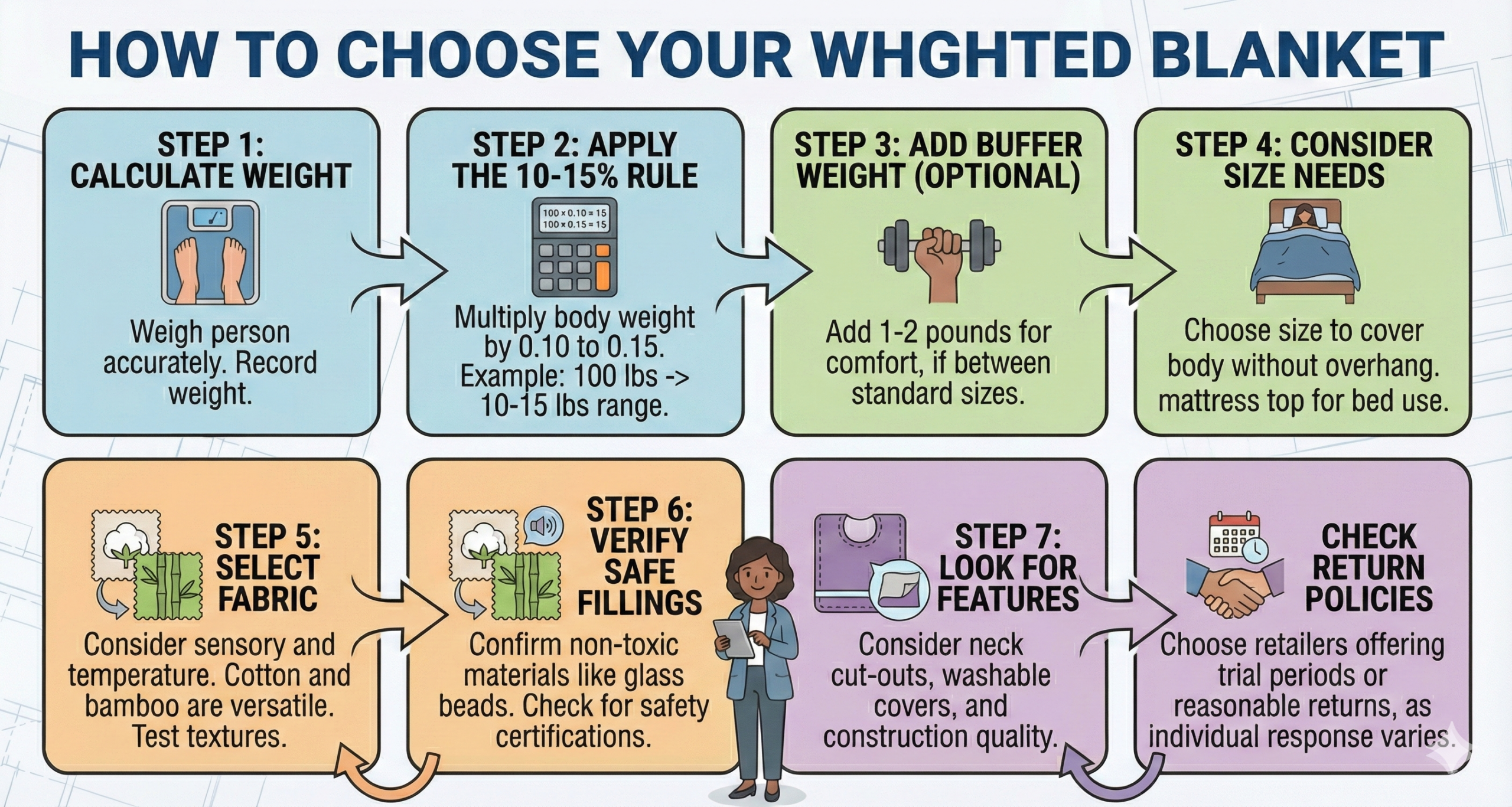
- Weigh the person who will use the blanket.
- Apply the 10% guideline (a bit less for young children; up to 15% for adults). Example: 100 lbs × 0.10 = 10 lbs.
- Round down, not up, if you’re between two sizes.
- Choose a size that covers the body, not the whole bed.
- Pick the fabric by sensory needs: cotton or bamboo if they run hot, knit if beads are too noisy.
- Check the filling and stitching: glass beads, small even pockets.
- Get a washable cover.
- Buy where returns are easy, because you won’t know until you try.
The Bottom Line
A weighted blanket is a comfort tool, not a treatment. Research hasn’t shown that it improves sleep in autistic children, but many autistic people find the pressure calming and like having it. If you want to try one, choose a weight around 10% of body weight, a fabric that suits their senses, and a seller with easy returns, then let the person decide whether it works for them.
Related Guides
- DIY Weighted Blanket for Autism: Complete Tutorial
- Sensory Items for Adults
- Sensory Diet Guide for Autism
- Blackout Tents for Sensory Needs
This guide is for general information and does not replace medical advice. Talk with your doctor or an occupational therapist about what’s right for your child.
Last updated: October 2026
Discover more from Living with Autism
Subscribe to get the latest posts sent to your email.


Thank you for sharing the benefits of weighted blankets. Although it may not be suitable for everyone and the response may vary. I’ve never tried that on my daughter but would ask her what she thinks of using one. She may tell me she would find it too heavy or hot for her. I really don’t know. I would use one for myself even.