7 Surprising Truths About Autism in Girls That Challenge Everything You Thought You Knew
When you hear the word “autism,” what comes to mind? For many, it’s a specific image, often shaped by media and early research: a young boy who avoids eye contact, speaks in a monotone, and is obsessively knowledgeable about trains or dinosaurs. While this stereotype holds true for some, it represents a narrow and dangerously incomplete picture of the autistic experience.
This male-centric model has caused generations of autistic girls and women to be overlooked, misunderstood, and misdiagnosed. Their autism often presents in subtle, internalized ways that don’t fit the classic mold. As a result, they learn to hide their true selves, paying a high psychological price by constantly depleting a finite energy reserve. This article reveals seven of the most surprising and impactful truths about the female autistic experience, challenging everything you thought you knew and shedding light on a hidden population.
——————————————————————————–
1. Socially “Normal” Hobbies Can Be Autistic Special Interests
Special interests are a well-known characteristic of autism, but in girls, the topic is often so socially acceptable that it flies completely under the radar. Instead of being flagged by clinicians, deep dives into subjects like K-pop lore, the chemistry of makeup, vintage fashion, literature, or celebrities are often dismissed as typical hobbies.
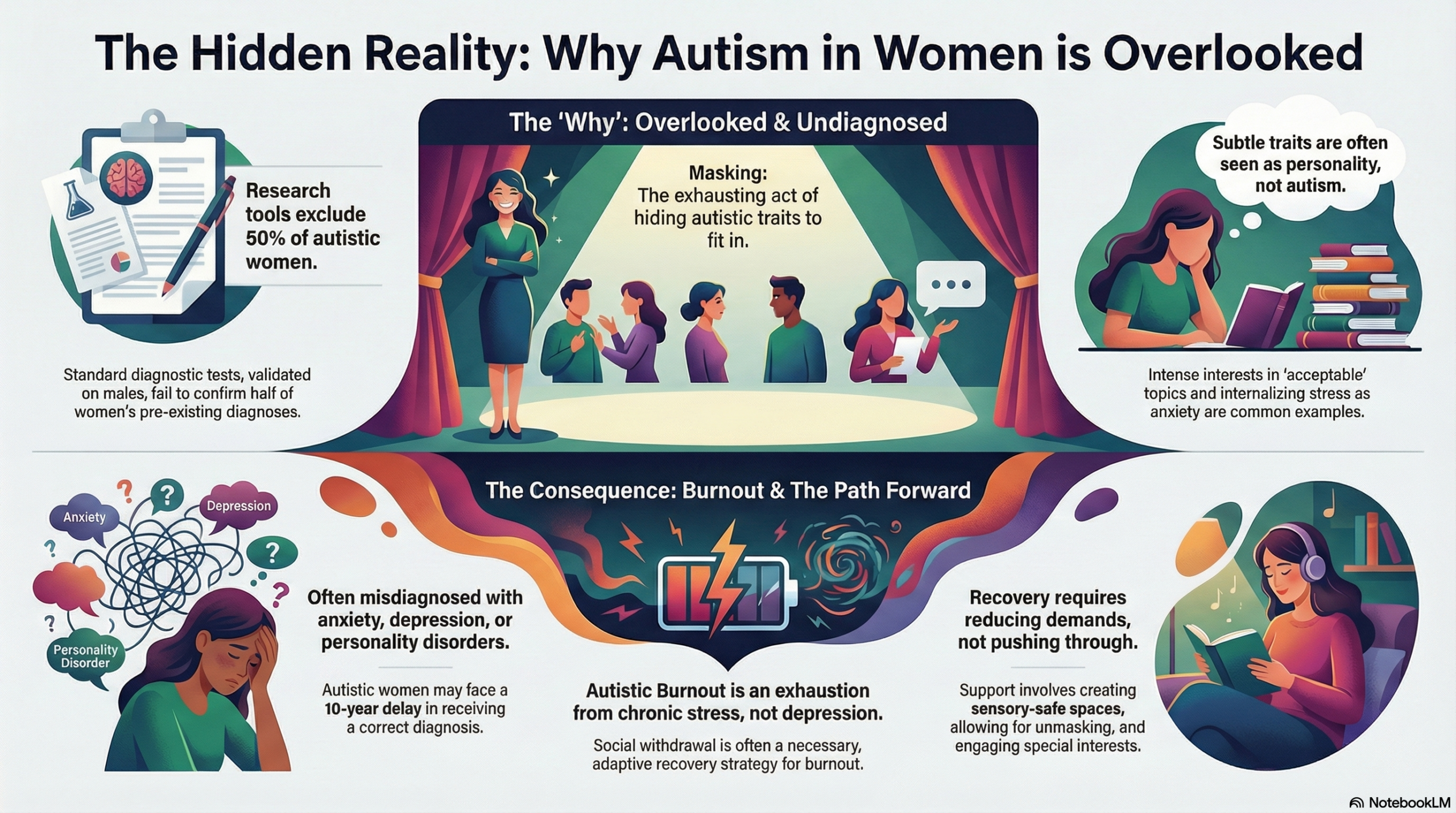
The diagnostic indicator isn’t the topic itself, but the intensity and quality of the engagement. While these interests bring intense joy, they also serve deeper, vital functions. They are a powerful tool for emotion regulation, acting as a “thought blocker for anxiety.” They become a way to build a strong sense of identity and self-worth, and they can be a crucial bridge for social engagement with others who share the same passion. Reframing these passions not as mere hobbies but as essential coping mechanisms and identity-builders reveals how a core autistic trait can be hidden in plain sight, contributing to years of missed diagnoses.
——————————————————————————–
2. Many Autistic Girls Aren’t Anti-Social—They’re Performing Social Skills 24/7
Contrary to the stereotype of social disinterest, many autistic girls have a high degree of social motivation and a strong desire to form friendships. To navigate a social world with rules they find confusing, they engage in a behavior known as “masking” or “camouflaging”—the conscious or unconscious suppression of autistic traits to fit in. This continuous performance is a profound drain on their daily energy budget.
This can be like “acting 24/7.” They might script small talk in their heads like TikTok drafts, meticulously copy the slang and gestures of their classmates, force eye contact even when it’s uncomfortable, or suppress natural impulses to stim (like hand-flapping). This creates an “illusion of competence,” where a girl appears socially adequate on the outside but is experiencing immense internal strain. The psychological cost of this constant performance is profound, as it sends the message that one’s authentic self is unacceptable.
“Masking happens in the context of being given the message at quite a young age that who you are and your natural, instinctive way of being is not okay, and that you will only be accepted if you shape yourself into something else. … I think as an autistic child, I was given the message that my entire job in life was to make other people feel comfortable. And I never thought about making myself feel comfortable.” – Purple Ella, Autistic Masking & Romantic Relationships
——————————————————————————–
3. The “Social Hangover” Is Real (and It’s Not Depression)
Have you ever seen a child have a complete meltdown or shutdown after a seemingly “perfect” day of social activity? This “social hangover” is a common experience for autistic individuals who have been masking. It’s a symptom of “Autistic Burnout”—a state of intense physical, mental, and emotional exhaustion caused by the prolonged cognitive, sensory, and social overload of trying to meet neurotypical expectations. This burnout is the direct result of an overdrawn energy budget.
Autistic burnout is often misdiagnosed as clinical depression, but they are fundamentally different states requiring different interventions. Misidentifying burnout as depression leads to ineffective treatments that fail to address the root environmental cause: the relentless demand to perform and the lack of accommodations.
| Characteristic | Autistic Burnout | Clinical Depression |
| Primary Cause | Prolonged social, sensory, and emotional overload from masking and lack of accommodations. | Multifactorial, including genetics, brain chemistry, trauma, and chronic stress. |
| Social Withdrawal | An adaptive (helpful) strategy used to recharge from overwhelm. | Often maladaptive (harmful), linked to a lack of interest, pleasure, and motivation. |
| Recovery Path | Requires rest, reduction of environmental demands, and opportunities to unmask. | Typically involves psychotherapy and/or pharmacological intervention. |
——————————————————————————–
4. Fierce Perfectionism Is Often a Shield for Anxiety
Another subtle sign of autism in girls can be fierce perfectionism. This might manifest as striving for straight-A’s, maintaining an impeccably tidy desk, or curating a perfect social media feed. On the surface, this behavior is often praised by teachers and parents.
In reality, this perfectionism is frequently a “shield that masks confusion and anxiety.” It is an energy-intensive strategy to impose rigid rules and order on a small part of one’s life, creating a predictable sanctuary when the unwritten rules of the social world feel chaotic and arbitrary. This attempt to create control directly contributes to the depletion of energy reserves that leads to the burnout described earlier. However, this shield is fragile. One tiny mistake or perceived failure can send the individual spiraling into self-blame and distress, revealing the deep-seated anxiety it was built to hide.
——————————————————————————–
5. Restrictive Eating Might Not Be About Body Image
Research shows a strong link between autism and eating disorders, but the drivers behind restrictive eating can be very different for autistic individuals. While both may involve severe food restriction, the critical diagnostic difference lies in the underlying motivation behind the behavior. Clinicians must differentiate between two conditions that can look similar on the surface:
• Anorexia Nervosa (AN): Restrictive eating driven by a distorted body image and an intense, pathological fear of gaining weight.
• Avoidant/Restrictive Food Intake Disorder (ARFID): Restrictive eating that is not driven by body image concerns.
In the autistic population, ARFID is common. The restriction is often rooted in core autistic traits, such as profound sensory sensitivities to the texture, taste, or smell of certain foods. Other drivers can include a general lack of interest in food or a fear of negative consequences, like choking. This distinction is critical, as a behavior that looks like a classic eating disorder may require a completely different therapeutic approach that addresses sensory processing differences rather than body image.
——————————————————————————–
6. Anxiety and Stress Are Often Internalized
While autistic boys are more likely to externalize stress through observable behavioral issues, autistic girls often internalize it. This can manifest physically as chronic tummy aches, insomnia, or sudden and unexplained mood swings. Parents and teachers may see a “model student” who is quiet and compliant, while internally, she is struggling with overwhelming anxiety.
This internalizing pattern contributes to a significantly higher prevalence of co-occurring anxiety and mood disorders in autistic female adolescents compared to their male counterparts. Consequently, many autistic girls are first treated for anxiety or depression—the symptoms—while the underlying neurotype causing the chronic stress—the root cause—goes unrecognized for years.
——————————————————————————–
7. The Diagnostic System Itself Is Biased
One of the most significant reasons autism in girls goes unrecognized is that the diagnostic system was built on a male-centric foundation. The seminal research that shaped our understanding of autism was overwhelmingly male-focused. Leo Kanner’s seminal 1943 paper described 11 children, only three of whom were girls, while Hans Asperger’s work focused exclusively on boys. This cemented an understanding of autism as a “male condition” and created a powerful bias in the “gold standard” diagnostic tools that followed.
These tools are often not sensitive enough to detect the more subtle female autistic phenotype, which is characterized by greater social motivation and more internalized traits. As a consequence, autistic women and girls are often diagnosed much later in life, if at all. Many spend years collecting a history of misdiagnoses—from anxiety and depression to eating disorders and even Borderline Personality Disorder—before they finally receive the explanation that fits their entire life experience.
Title: Unmasking Autism in Girls & Women: Masking, Burnout, and the "Model Student" by marketing
——————————————————————————–
The female autistic experience is far more nuanced, complex, and hidden than traditional stereotypes suggest. From socially acceptable interests that mask obsessive focus to the exhausting, 24/7 performance of “normalcy,” the signs are often misinterpreted or missed entirely by a system that wasn’t designed to see them. The cumulative cost of this invisibility—the relentless energy drain of masking, burnout, misdiagnosis, and unmet needs—is immense.
Knowing that so many autistic traits in women are camouflaged as acceptable behaviors or mislabeled as other conditions, how can we become better at looking past the mask and offering the right support to a hidden generation?
Discover more from Living with Autism
Subscribe to get the latest posts sent to your email.


1 Response
[…] pattern of late diagnosis autism female experiences is not a coincidence—it’s the result of a fundamental misunderstanding of what autism is. […]