IDRlabs Autism Test: What It Measures, How Accurate It Is & What Your Results Mean
Short answer (updated October 2026): The IDRlabs Autism Spectrum Test is a free online self-report quiz (currently 50 statements) that shows a profile of autism-related traits across 10 areas. It has not been validated in published, peer-reviewed research as a diagnostic screener, so it cannot tell you whether you are autistic. Use it for self-reflection, then try a better-studied screener such as our free AQ-50 test (Baron-Cohen et al., 2001) or the RAADS-R, and see how to get tested as an adult.
Have you come across the IDRlabs autism test and wondered whether it is a reliable way to explore autistic traits? You’re not alone: online screeners are often the first step people take. This guide explains what the IDRlabs test actually measures, how it differs from research-validated questionnaires, and what your results can (and can’t) tell you. In short: it is an informal self-reflection tool, not a diagnostic instrument.
What Is the IDRlabs Autism Spectrum Test?
IDRlabs is a website (established in 2009) that publishes free online psychology quizzes. Its best-known autism quiz, the Autism Spectrum Test, currently asks you to rate 50 statements on a scale from “Disagree” to “Agree”. IDRlabs says the test is based on the work of the researchers behind the Adult Repetitive Behaviours Questionnaire-2 (RBQ-2A; Barrett et al., 2015) and related autism research, and it states that it is not associated with those researchers.
Instead of a single pass/fail score, the results page shows a profile across 10 areas:
- Social difficulty
- Fixations (intense or restricted interests)
- Abnormal or flat speech
- Noise sensitivity
- Poor eye contact
- Tics and fidgets
- Abnormal posture
- Anxiety
- Depression
- Aggression
Notice that several of these areas (anxiety, depression, aggression) are not specific to autism. They are common in many conditions, which is one reason the profile should be read with care. Note: an earlier version of this article described a 24-question version with fixed score bands. IDRlabs updates its quizzes, and the current test does not use those bands, so we have removed them.
Other IDRlabs Autism Tests
IDRlabs hosts many autism-related quizzes, which is why search results can be confusing. The main ones:
| IDRlabs quiz | Based on | Better-studied original |
|---|---|---|
| Autism Spectrum Test | RBQ-2A and related research (per IDRlabs) | RBQ-2A (Barrett et al., 2015) measures repetitive behaviors only |
| Autism Spectrum Quotient (AQ) Test | Baron-Cohen’s AQ | AQ-50 (Baron-Cohen et al., 2001) |
| Autism/Asperger Test | Ritvo Autism Asperger Diagnostic Scale | RAADS-R (Ritvo et al., 2011) |
| Camouflaging Autistic Traits Questionnaire | CAT-Q | CAT-Q (Hull et al., 2019) |
| Reading the Mind in the Eyes | RMET | RMET (Baron-Cohen et al., 2001), a research task, not a diagnostic test |
If you want a score you can compare with published research, it is usually better to take the original questionnaire with its published scoring than an adapted version.
Who Is It For?
The IDRlabs Autism Spectrum Test is a self-report quiz written for adults and older teens. It may be useful if you:
- Are an adult wondering whether some of your experiences fit autistic traits
- Want words to describe your traits before talking to a doctor or psychologist
- Are curious about how different trait areas (sensory, social, repetitive behaviors) show up for you
It is not designed for screening young children. For toddlers, use a validated parent questionnaire such as the M-CHAT-R/F (try our free toddler screener) and talk to your pediatrician.
How Accurate Is the IDRlabs Autism Test?
Nobody knows how accurately it identifies autism, because no peer-reviewed study has tested it against clinical diagnoses. IDRlabs says its tests undergo statistical checks and links an internal psychometric review, but that is not the same as independent, published validation with diagnosed and non-diagnosed groups.
Even well-studied self-report screeners have real limits. In a study of more than 400 adults referred for an autism assessment, the AQ did not reliably separate those who received a diagnosis from those who did not (Ashwood et al., 2016). An adapted online quiz is unlikely to do better. Things that can push a score up or down:
- Other conditions: anxiety, depression, ADHD, social anxiety and trauma can raise scores on social and sensory items.
- Masking: people who camouflage autistic traits (often women) may under-report them.
- Self-insight and mood: how you feel on the day, and how you see yourself, shape your answers.
- Non-specific items: the anxiety, depression and aggression areas reflect general distress, not autism itself.
How to Read Your Results
IDRlabs does not publish an official cutoff for this test, so there is no score that “means” autism. A more useful way to read the profile:
- Higher on several core areas (social difficulty, fixations, noise sensitivity, poor eye contact, repetitive movements) suggests it is worth learning more and taking a validated screener.
- High mainly on anxiety or depression suggests talking to a doctor about mental health, whether or not autism is part of the picture.
- Low scores but you strongly relate to autistic experiences: masking can hide traits, so a low score does not rule autism out.
IDRlabs vs. Validated Screeners
| Screener | Items | Published cutoff | Evidence |
|---|---|---|---|
| IDRlabs Autism Spectrum Test | 50 | None (trait profile) | No peer-reviewed validation |
| AQ-50 | 50 | 32+ (original study) | Widely studied; many false positives in clinical referrals |
| AQ-10 | 10 | 6+ (referral threshold) | Used by the UK’s NICE as a referral screen |
| RAADS-R | 80 | 65+ | Designed to support clinical diagnosis; online use less accurate |
| CAT-Q | 25 | None for diagnosis | Measures camouflaging, not autism itself |
What to Do After the Test
- Write down examples. Specific situations from childhood and adult life are far more useful to a clinician than any quiz score.
- Take a validated screener such as the AQ-50 or RAADS-R and bring the results to your appointment.
- Ask for an assessment if traits affect your daily life. Start with your doctor, or read our guide on how to get tested for autism as an adult.
- Look after your mental health. If the depression or anxiety areas were high, talk to a doctor. If you ever feel unsafe, in the US call or text 988.
Preparing for the Test
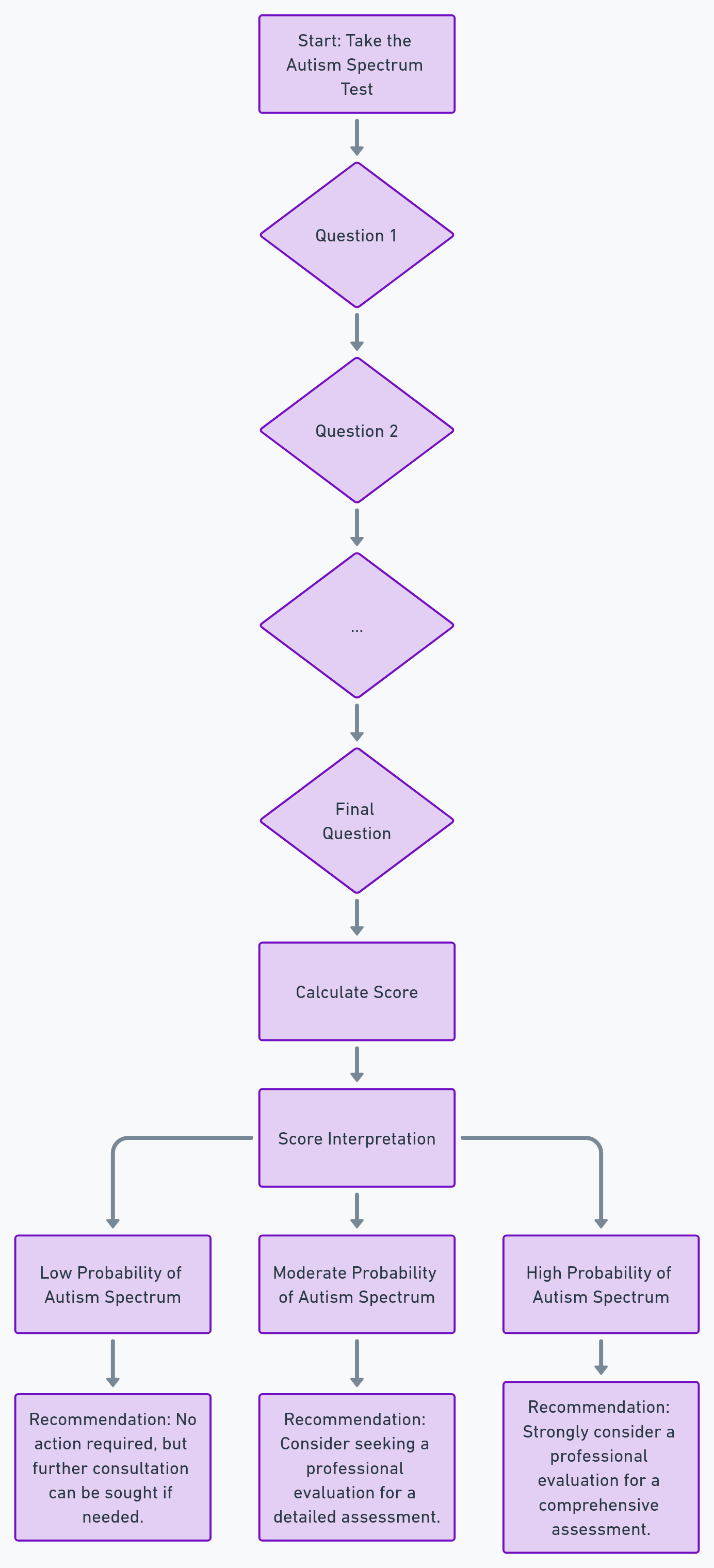
- Take it when you’re alone and not rushed
- Answer based on your everyday behavior, not how you wish you behaved
- Choose the response closest to your experience and don’t overthink it
Who Makes IDRlabs?
IDRlabs is an online quiz publisher that has been running since 2009. The autism test page says it was developed by IDRlabs with input from people who work in psychology, and that it was academically reviewed by a named psychology professor. What the site does not provide is what you would expect from a clinical tool: a peer-reviewed validation study, the sample it was tested on, sensitivity and specificity figures, or published norms. That is why we recommend treating it as an educational quiz.
Want research-based questionnaires instead? Our guide to the Embrace Autism tests explains the free AQ, RAADS-R and CAT-Q versions and what their scores mean.
Thinking about an adult autism assessment?
An IDRlabs profile is not a diagnosis, but it can help you notice patterns worth discussing. Clinicians will ask about your childhood, daily challenges and concrete examples, and it is easy to go blank in the room. The printable Pre-Assessment Checklist helps you write down what you have noticed, gather records and prepare your questions before the appointment.
Get the Pre-Assessment Checklist (PDF)
Instant download from 101Autism.com. A preparation tool, not a diagnostic test.
FAQ
Is the IDRlabs autism test accurate?
Its accuracy for identifying autism is unknown, because it has not been validated in published, peer-reviewed research. It can reflect your self-reported traits, but it cannot diagnose autism or rule it out.
How many questions are on the IDRlabs autism test?
The current IDRlabs Autism Spectrum Test has 50 statements rated from disagree to agree. IDRlabs also offers other autism quizzes, including an AQ version with 50 items and shorter 3-minute tests.
What is a high score on the IDRlabs autism test?
IDRlabs does not publish an official cutoff. Results are shown as a profile across 10 trait areas. Higher scores on several core areas suggest taking a validated screener and possibly seeking an assessment.
Can I use my IDRlabs result to get diagnosed?
No. A diagnosis requires a clinical assessment by a qualified professional. You can bring your results and personal examples to the appointment as background.
Additional Resources
Organizations: Autism Society, Autistic Self Advocacy Network, The Transmitter (autism research news, formerly Spectrum).
Books: “NeuroTribes” by Steve Silberman, “The Autistic Brain” by Temple Grandin, “The Reason I Jump” by Naoki Higashida. (Amazon affiliate links: as an Amazon Associate, 101Autism earns from qualifying purchases.)
Sources: IDRlabs, Autism Spectrum Test page (accessed October 2026); Barrett SL et al. The Adult Repetitive Behaviours Questionnaire-2 (RBQ-2A). J Autism Dev Disord. 2015;45(11):3680-3692; Baron-Cohen S et al. The Autism-Spectrum Quotient (AQ). J Autism Dev Disord. 2001;31(1):5-17; Allison C et al. Toward brief “red flags” for autism screening (AQ-10). J Am Acad Child Adolesc Psychiatry. 2012;51(2):202-212; Ritvo RA et al. The RAADS-R. J Autism Dev Disord. 2011;41(8):1076-1089; Ashwood KL et al. Predicting the diagnosis of autism in adults using the AQ. Psychol Med. 2016;46(12):2595-2604. Written by Dror Arbel, a parent, not a clinician. Last updated October 2026.
Discover more from Living with Autism
Subscribe to get the latest posts sent to your email.


1 Response
[…] IDRlabs Autism Spectrum […]