Is ADHD a Form of Autism? Understanding the Key Differences and Overlaps

TL;DR
ADHD and autism are NOT the same condition. They are two distinct neurodevelopmental disorders with different diagnostic criteria, though they frequently co-occur and share some overlapping symptoms. ADHD primarily affects attention, impulse control, and hyperactivity, while autism centers on social communication challenges and restricted/repetitive behaviors. Research shows that 30-80% of autistic individuals also have ADHD. Both conditions involve differences in brain development. They also affect executive functioning. Accurate diagnosis matters because treatment approaches differ significantly between the two conditions.
Understanding the Connection: Why People Ask This Question
If you’re wondering whether ADHD is a type of autism, you’re not alone. Many parents, educators, and even adults seeking diagnosis find themselves confused by the similarities between these two conditions. Both affect how the brain processes information, both can impact social interactions, and both are often diagnosed in childhood. However, understanding the crucial distinctions can lead to better support, more effective interventions, and greater self-understanding.
The short answer is: No, ADHD is not a form of autism. They are separate neurodevelopmental conditions with their own diagnostic criteria. But the relationship between them is more nuanced than a simple yes or no answer suggests.
ADHD vs. Autism: Quick Comparison Table
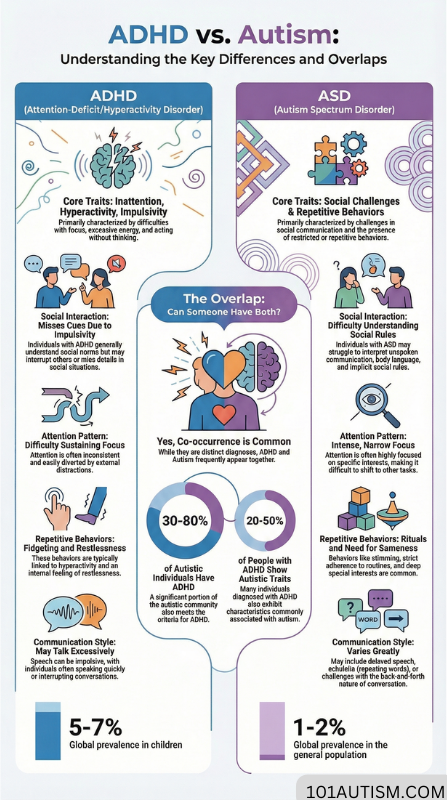
| Aspect | ADHD | Autism Spectrum Disorder (ASD) |
|---|---|---|
| Primary Characteristics | Inattention, hyperactivity, impulsivity | Social communication challenges, restricted/repetitive behaviors |
| Social Differences | May interrupt or miss social cues due to impulsivity; generally understands social norms | Difficulty understanding social rules, body language, and unspoken communication |
| Attention Patterns | Difficulty sustaining attention; easily distracted | Intense focus on specific interests; difficulty shifting attention |
| Repetitive Behaviors | Fidgeting, restlessness due to hyperactivity | Stimming, rituals, need for sameness, special interests |
| Sensory Issues | Less common but possible | Very common; hyper or hypo-sensitivity to stimuli |
| Communication | May talk excessively or impulsively | May have delayed speech, echolalia, or difficulty with pragmatic language |
| Executive Function | Poor planning, organization, time management | Challenges with flexibility, planning, transitioning between tasks |
| Prevalence | 5-7% of children globally | 1-2% of population globally |
| Can They Co-occur? | Yes, 30-80% of autistic individuals also have ADHD | Yes, 20-50% of people with ADHD show autistic traits |
What Is ADHD?
Attention-Deficit/Hyperactivity Disorder (ADHD) is a neurodevelopmental condition characterized by persistent patterns of inattention and/or hyperactivity-impulsivity that interfere with daily functioning. There are three presentations:
- Predominantly Inattentive: Difficulty focusing, following instructions, organizing tasks
- Predominantly Hyperactive-Impulsive: Excessive movement, fidgeting, difficulty waiting turns
- Combined Presentation: Both inattentive and hyperactive-impulsive symptoms
People with ADHD often struggle with executive functions like working memory, emotional regulation, and time management. They may lose things frequently, make careless mistakes, or act without thinking through consequences.
What Is Autism?
Autism Spectrum Disorder (ASD) is a neurodevelopmental condition that affects how people communicate, interact socially, and experience the world around them. The core features include:
- Social Communication Challenges: Difficulty with back-and-forth conversation, understanding nonverbal cues, developing and maintaining relationships
- Restricted and Repetitive Behaviors: Repetitive movements (stimming), insistence on sameness, highly focused interests, unusual sensory responses
Autism exists on a spectrum, meaning it affects people differently and with varying intensity. Some autistic individuals are nonspeaking and require substantial support, while others live independently with minimal accommodations.
The Overlap: Why the Confusion Exists
The confusion between ADHD and autism is understandable because they share several features:
Shared Characteristics:
- Executive Function Challenges: Both conditions involve difficulties with planning, organization, and flexible thinking
- Social Difficulties: While the underlying causes differ, both can impact peer relationships
- Sensory Sensitivities: Though more common in autism, people with ADHD can also experience sensory processing differences
- Emotional Regulation Issues: Both groups may struggle with managing emotions appropriately
- Higher Rates of Anxiety and Depression: Both conditions carry increased risk for mental health challenges
Key Research Findings:
Studies have shown that ADHD and autism frequently co-occur at rates far higher than chance would predict. Research indicates that approximately 30 to 80 percent of autistic children also meet criteria for ADHD, while 20 to 50 percent of children with ADHD display significant autistic traits.
Both conditions involve differences in brain development, particularly in areas related to executive functioning, attention networks, and reward processing. Some genetic factors also overlap between the two conditions, suggesting shared biological underpinnings.
Critical Differences That Matter for Diagnosis
Despite the overlap, several key differences distinguish ADHD from autism:
Social Understanding
People with ADHD typically understand social rules and norms but may struggle to apply them due to impulsivity or inattention. They might interrupt conversations because they’re excited or lose track of what someone is saying because their mind wandered.
Autistic individuals often find social rules confusing or arbitrary. They may not naturally pick up on body language, tone of voice, or implied meanings. The social world can feel like a foreign language that others seem to speak fluently.
Nature of Attention Differences
ADHD involves difficulty regulating attention across contexts. Someone with ADHD might struggle to focus on homework but also find it hard to stick with a video game if it becomes frustrating.
Autism often involves intense, sustained focus on specific interests. An autistic person might spend hours absorbed in learning everything about trains, astronomy, or a particular historical period, showing remarkable attention when engaged with preferred topics.
Motivation Behind Repetitive Behaviors
Repetitive behaviors in ADHD, like fidgeting or pacing, typically serve to manage excess energy or maintain alertness. They’re often unconscious and not particularly meaningful to the person.
Repetitive behaviors in autism, such as hand flapping, rocking, or lining up toys, often serve regulatory purposes related to sensory needs or emotional comfort. These behaviors may be deeply important for managing stress or processing sensory input.
Can You Have Both ADHD and Autism?
Absolutely yes. In fact, having both conditions is quite common. Until 2013, the diagnostic manual (DSM-IV) didn’t allow clinicians to diagnose both conditions simultaneously. The DSM-5 changed this, recognizing that many people genuinely meet criteria for both disorders.
When someone has both ADHD and autism, they experience a unique combination of challenges. They might struggle with:
- Reading social cues (autism) AND interrupting conversations impulsively (ADHD)
- Needing predictable routines (autism) AND struggling to follow through on planned activities (ADHD)
- Sensory overwhelm (autism) AND restlessness that makes it hard to remove themselves from overstimulating situations (ADHD)
Having both diagnoses helps ensure comprehensive support that addresses the full range of needs.
Why Accurate Diagnosis Matters
Getting the right diagnosis is crucial because treatment approaches differ:
ADHD Interventions:
- Stimulant medications (methylphenidate, amphetamines) are highly effective for many people
- Behavioral strategies focusing on external structure, rewards, and breaking tasks into manageable steps
- Accommodations like extended time, fidget tools, or movement breaks
- Executive function coaching
Autism Interventions:
- Social skills training that explicitly teaches social concepts
- Sensory accommodations and strategies
- Communication supports (AAC devices, visual schedules)
- Interventions respecting autistic identity while building skills
- Therapy focusing on co-occurring anxiety or depression common in autism
For Co-occurring ADHD and Autism:
Treatment must address both sets of challenges, which sometimes requires creative problem-solving. For example, someone might benefit from ADHD medication to help with focus while also needing sensory-friendly environments and explicit social instruction.
Common Misconceptions Debunked
Misconception 1: “ADHD is just mild autism” Reality: These are distinct conditions with different core features. ADHD is not a less severe version of autism.
Misconception 2: “Everyone with autism has attention problems” Reality: While many autistic people struggle with attention regulation, the pattern differs from ADHD. Autistic attention difficulties often relate to difficulty shifting focus or filtering out sensory distractions.
Misconception 3: “If you can focus on things you like, you don’t have ADHD” Reality: Interest-based attention is actually characteristic of ADHD. The challenge is regulating attention for non-preferred tasks.
Misconception 4: “You can’t have both conditions” Reality: Current research and diagnostic criteria recognize that ADHD and autism frequently co-occur.
Getting an Accurate Assessment
If you’re seeking evaluation for yourself or your child, consider the following:
Find the Right Professional
Look for psychologists, psychiatrists, or developmental pediatricians who have specific experience assessing both ADHD and autism. Comprehensive evaluations should include:
- Detailed developmental history
- Behavioral observations
- Standardized rating scales for both conditions
- Assessment of cognitive abilities and language skills
- Consideration of sensory processing and executive functioning
Be Thorough in Providing Information
Share examples of behaviors in multiple settings (home, school, work, social situations). Video recordings can be particularly helpful for showing natural behaviors.
Consider Co-occurring Conditions
Both ADHD and autism frequently occur alongside anxiety, learning disabilities, sleep disorders, and other conditions. A comprehensive evaluation examines the full picture.
Remember: Labels Are Tools
Diagnoses exist to help people access appropriate support and better understand themselves. The goal isn’t to fit perfectly into a diagnostic box but to identify what helps you or your child thrive.
Frequently Asked Questions (FAQ)
Q: Is ADHD on the autism spectrum?
A: No, ADHD is not on the autism spectrum. They are separate diagnostic categories, though they can and do co-occur in the same individual. The autism spectrum refers to the range of ways autism presents across different people, not to a continuum that includes other conditions.
Q: Can ADHD turn into autism or vice versa?
A: No. Both are neurodevelopmental conditions present from early development. While symptoms may become more or less apparent over time due to various factors, one condition does not transform into the other. However, it’s possible for someone to be diagnosed with one condition first and later receive an additional diagnosis as understanding of their profile deepens.
Q: Are the causes of ADHD and autism the same?
A: Both conditions have strong genetic components and involve differences in brain development, and some genetic risk factors overlap. However, they also have distinct neurobiological profiles. ADHD is associated with differences in dopamine systems and attention networks, while autism involves broader differences in brain connectivity, sensory processing, and social cognition circuits.
Q: Which is more common, ADHD or autism?
A: ADHD is more common, affecting approximately 5 to 7 percent of children globally, compared to autism which affects 1 to 2 percent of the population. However, both conditions are increasingly recognized and diagnosed.
Q: Do ADHD and autism require different medications?
A: Yes, typically. Stimulant medications are first-line treatment for ADHD and highly effective for many people. There are no medications that treat the core features of autism, though medications may be used to address co-occurring conditions like anxiety, ADHD, or sleep problems in autistic individuals.
Q: Can someone be highly intelligent and still have ADHD or autism?
A: Absolutely. Both conditions occur across the full range of cognitive abilities. Many people with ADHD or autism have average to above-average intelligence. In fact, giftedness can sometimes mask symptoms, leading to later diagnosis.
Q: How do I know if my child has ADHD, autism, or both?
A: Professional evaluation is essential. Look for a qualified clinician who can conduct comprehensive testing. Key differences to observe: Does your child understand social expectations but struggle to follow them due to impulsivity (more ADHD-like), or do social rules seem genuinely confusing or arbitrary to them (more autism-like)? Are attention difficulties consistent across all activities, or can they focus intensely on preferred interests?
Q: Are girls and women with ADHD or autism different from boys and men?
A: Yes, research shows that ADHD and autism can present differently across genders. Girls and women are often underdiagnosed because they may show less obvious hyperactivity (in ADHD) or may learn to mask social difficulties more effectively (in autism). Women with either condition often develop compensatory strategies that hide their challenges until later in life when demands exceed their coping capacity.
The Bottom Line: Two Distinct but Related Conditions
ADHD is not a form of autism, but the two conditions are neurological neighbors. They share some common features, frequently occur together, and both involve differences in how the brain develops and functions. Understanding the distinctions matters because it guides us toward the most effective support strategies.
Whether you’re parenting a child with one or both conditions, navigating your own diagnosis, or working as an educator or clinician, recognizing both the similarities and differences between ADHD and autism empowers better understanding, reduces stigma, and improves outcomes.
The most important takeaway is this: Every person with ADHD or autism is unique. Diagnostic labels provide a starting point for understanding and accessing support, but the real work lies in discovering what helps each individual thrive in their own way.
Additional Resources
For families and individuals seeking support for ADHD, autism, or both conditions, explore our comprehensive guides:
- Understanding Autism Diagnosis: A Complete Guide – Navigate the assessment process with confidence
- ADHD Strategies for Daily Success – Practical tips for managing attention challenges
- Supporting Co-occurring ADHD and Autism – Specialized approaches when both diagnoses are present
- Sensory Processing in Neurodevelopmental Conditions – Understanding sensory differences across ADHD and autism
At 101Autism.com, we’re committed to providing evidence-based, compassionate resources for the autism and neurodivergent community. Subscribe to our newsletter for the latest research, practical strategies, and community stories.
Have questions about ADHD, autism, or related conditions? Connect with our community or consult with qualified professionals who can provide personalized guidance for your unique situation.
Important Disclaimer
This article is for educational and informational purposes only. I am not a medical professional, psychologist, autism specialist, or licensed clinician. I am a blogger with a personal interest in autism and neurodevelopmental conditions who has researched this topic to share helpful information with the community.
This content should NOT be used as a substitute for professional medical advice, diagnosis, or treatment. If you or your child are experiencing symptoms of ADHD, autism, or any other developmental concerns, please consult with qualified healthcare professionals such as:
- Licensed psychologists
- Developmental pediatricians
- Psychiatrists
- Board-certified behavior analysts (BCBAs)
- Other credentialed specialists in neurodevelopmental disorders
Always seek the advice of your physician or other qualified health provider with any questions you may have regarding a medical or developmental condition. Never disregard professional medical advice or delay seeking it because of something you have read on this blog.
Discover more from Living with Autism
Subscribe to get the latest posts sent to your email.



1 Response
[…] excellent for relieving stress, improving focus, and even helping to manage conditions like ADHD and autism. Here are a few […]